
Gilbert Bayes: Bringing Art into Everyday Life in Somers Town
Gilbert Bayes, born on April 4, 1872, at 6 Oval Road in Camden Town, was one of Britain’s most visionary sculptors. His versatile career encompassed fine art, ceramics, and public commissions—from designing for Royal Doulton to crafting the iconic Queen of Time figure that crowns the clock above Selfridges on Oxford Street. His artistic influence also adorns the sporting sculptures outside Lord’s cricket ground and the frieze Drama Through the Ages, still visible on the former Saville Theatre, now the Odeon Covent Garden.
Serving as president of the Royal Society of Sculptors from 1939 to 1944, Bayes’s influence continues today through the Gilbert Bayes Award, which supports emerging sculptors.
In the 1930s, Bayes was invited to infuse “art into everyday life” in Somers Town. Inspired by fairy tales and the saints who lent their names to local housing estates, he adorned communal courtyards with playful ceramic finials—sculptural ornaments perched atop washing-line posts. He crafted roughly 200 of these distinctive pieces. One courtyard showcased twenty-four blackbird finials encircling a central pie, a charming reference to the nursery rhyme. Another celebrated St Anthony preaching to the fish, featuring colourful ceramic fish as decorative finials.
Bayes also created semi-circular lunettes and other whimsical architectural details for estate buildings, brightening everyday surroundings with imagination and charm. Though many of these works survived World War II, later decades saw widespread theft and damage, leaving only a few originals remaining.
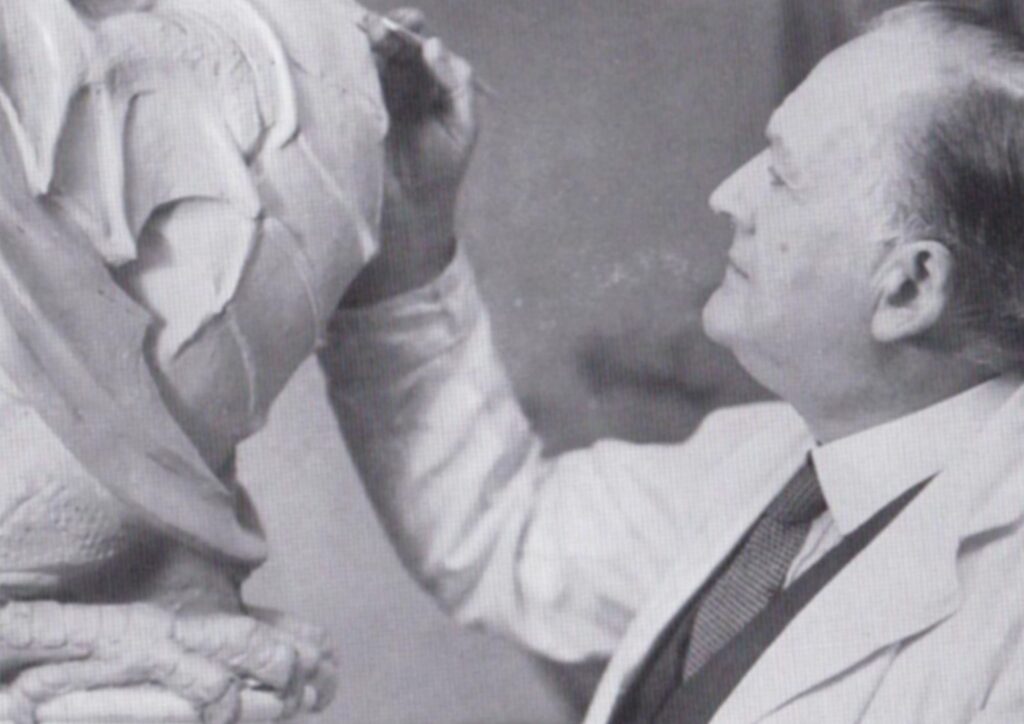
Gilbert Bayes modelling the dragon finial for the St Pancras Housing Association in 1937
Several examples are preserved in the British Library’s basement collection, and replicas now brighten local streets. On Aldenham Street, ship-shaped finials circle a Christmas tree near a plaque honouring Father Basil Jellicoe, the social reformer behind the ‘Housing is Not Enough’ campaign. The community-led People’s Museum in Somers Town has even reclaimed two original Bayes finials at auction, part of its ongoing mission to protect the area’s heritage.
The museum is a vibrant treasure trove of local history, featuring everything from a Pearly Queen costume to fascinating artifacts such as oversized models of fleas and bed bugs, symbolizing the infestations that plagued the slums before Father Basil Jellicoe’s reforms. A Frankenstein figure is also on display to represent the fact that Mary Shelley lived in Somers Town and wrote the story here.
The playful spirit of Bayes endures here as well; one of his whimsical inspirations—a Scottish poem about twenty-four tailors chasing a snail—is vividly brought to life as colourful street art on the museum’s shutters.